În figura alăturată, triunghiul \(ABC\) este isoscel cu \(AB = AC\) și \(\angle BAC = 120°\). Punctul \(E\) se află pe dreapta \(BC\) astfel încât \(CE = 4\text{ cm}\) și \(AE \perp AB\). Lungimea segmentului \(BC\) este egală cu:
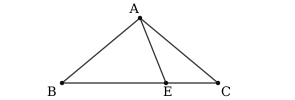
Într-un triunghi isoscel cu \(AB=AC\), unghiurile bazei sunt egale: \(\angle ABC = \angle ACB\).
Dacă \(\angle BAE = 90°\), atunci în triunghiul dreptunghic \(ABE\): \(\cos(\angle ABE) = \dfrac{AB}{BE}\).
Într-un triunghi cu \(\angle BAC = 120°\): \(BC^2 = AB^2 + AC^2 - 2 \cdot AB \cdot AC \cdot \cos(120°) = 3 \cdot AB^2\).
\(AB = AC\); \(\angle BAC = 120°\); \(CE = 4\text{ cm}\); \(AE \perp AB\)
\(\angle ABC = \angle ACB = \dfrac{180° - 120°}{2} = 30°\)
\(BC^2 = AB^2 + AB^2 - 2 \cdot AB^2 \cdot \cos(120°) = 2AB^2 + AB^2 = 3AB^2\)
\(BC = AB\sqrt{3}\)
\(\angle BAE = 90°\), \(\angle ABE = 30°\), deci \(\angle AEB = 60°\).
Din \(\cos(30°) = \dfrac{AB}{BE}\) rezultă \(BE = \dfrac{AB}{\cos(30°)} = \dfrac{2AB}{\sqrt{3}}\).
\(AB\sqrt{3} = \dfrac{2AB}{\sqrt{3}} + 4\)
\(AB\sqrt{3} - \dfrac{2AB}{\sqrt{3}} = 4\)
\(AB \cdot \dfrac{3-2}{\sqrt{3}} = 4 \Rightarrow \dfrac{AB}{\sqrt{3}} = 4 \Rightarrow AB = 4\sqrt{3}\text{ cm}\)
\(BC = AB\sqrt{3} = 4\sqrt{3} \cdot \sqrt{3} = 12\text{ cm}\)